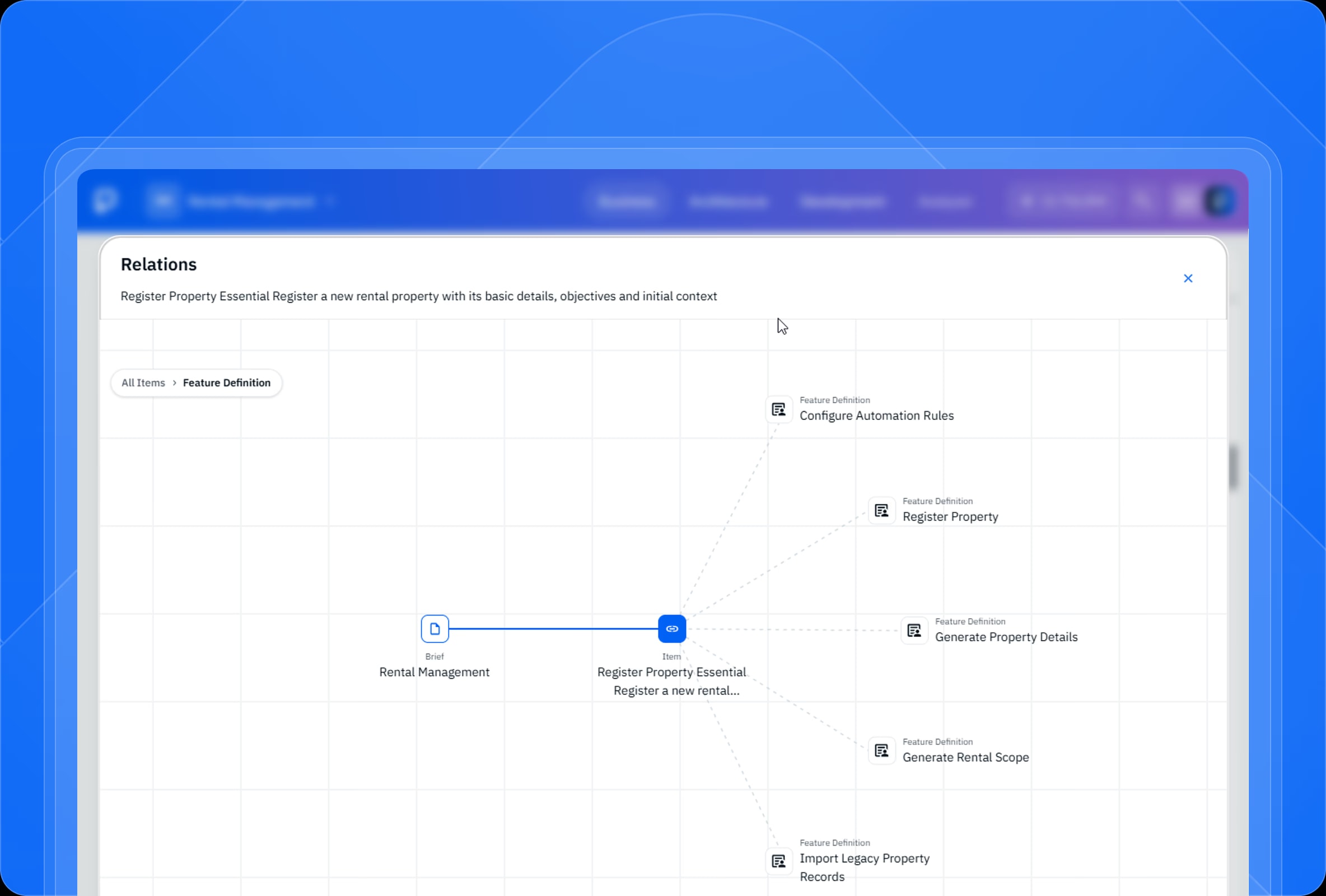
Upstream / downstream relations graph
Select any artifact and see what depends on it and what it depends on — across business, architecture, and code.

Any change triggers a three-dimensional impact analysis. Concurrent users stay aligned, not fragmented.
Extracting real value from AI requires synchronizing the speed of innovation with the reliability of the process across every layer.
Through centralized context management, any functional or technical change triggers a three-dimensional impact-and-risk analysis. The system ensures consistency between existing implementations and the in-progress definitions of multiple concurrent users — securing a decision model that is collaborative, simultaneous, and free of fragmentation.
Select any artifact and see what depends on it and what it depends on — across business, architecture, and code.
A business-rule edit surfaces architectural impacts and code impacts in the same view — no separate impact ticket.
Two analysts editing related rules see each other's in-progress changes. Merge conflicts surface at the spec layer, not at the PR layer.
Dependency edges carry Low / Medium / High risk badges. Sign-off decisions see structural impact before they ship.
Surfaces inside the Analyzer workspace, across two sub-tabs: Context (project metadata and discriminators that scope each review) and Relations (the upstream/downstream graph linking every artifact). Cross-layer impact also surfaces inline during review in any workspace.
Engineering managers eliminate the hidden coupling that produces midnight incidents. Architects see structural impact before decisions ship. Compliance gets risk visibility at change time, not after the fact.

Tell us about your team and we'll tailor a walkthrough to your stack, your governance needs, and the way you ship.